Join the community . Follow TNBC on YouTube, newsletter, and X
TNBC Political Power Map
Political Power Map — Where Political Power Operates
Power does not sit still.
It operates across society — between individuals, institutions, and the state — shaping how decisions are made and how behavior is guided.
What often appears complex is structured.
Power does not exist in one place. It moves within a system.
This map shows where power operates — and how it shifts.
Power tends to shift from distributed influence toward more centralized and direct forms of control as pressure builds.
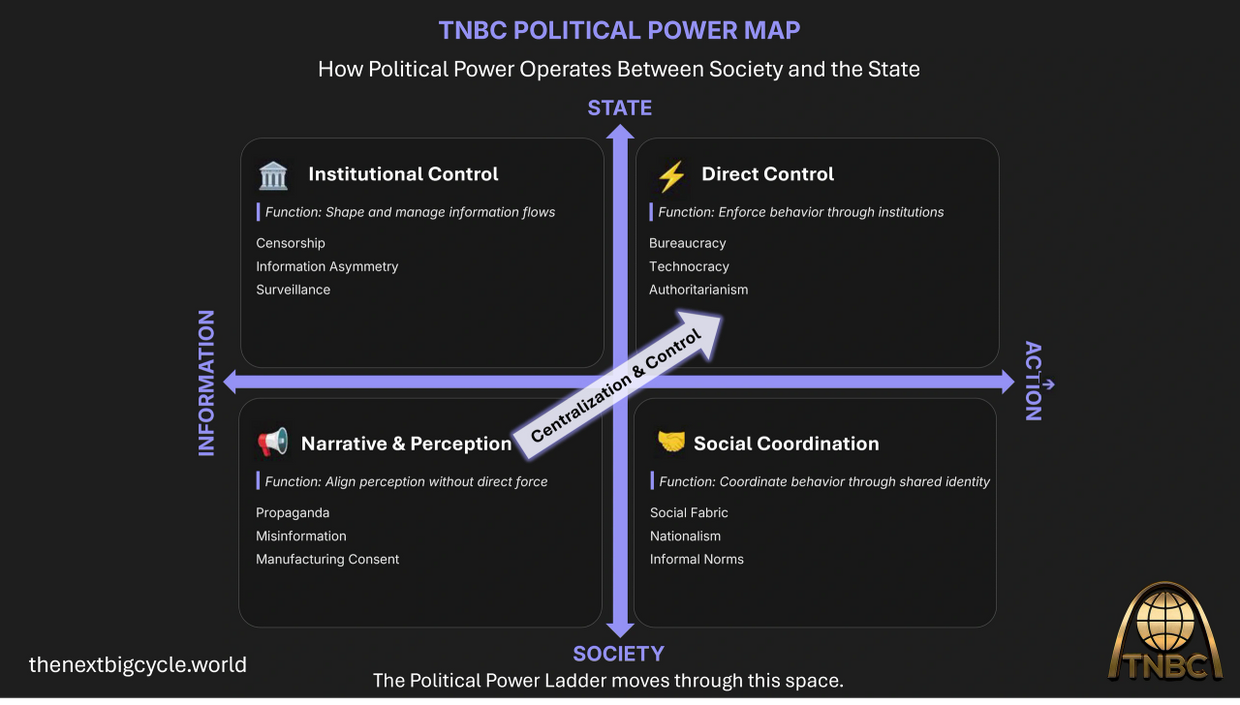
Most systems move along the diagonal — toward more centralized and direct forms of power.
How to Read the Map
The vertical axis shows where power sits — from society at the bottom to the state at the top.
The horizontal axis shows how power operates — from shaping information to directing action.
Movement across the map reflects a shift toward more centralized and direct forms of control.
What This Means
Power can influence how people think, or directly shape what they do.
It can emerge from social coordination, or be enforced through institutions.
As systems grow and face pressure, power tends to become more centralized and more direct.
How to Use the Map
Start with what you observe.
Then locate it within the system.
Where is power operating?
Is it shaping perception or enforcing behavior?
Is it distributed across society or concentrated in institutions?
This turns events into structure.
Why This Matters
What often appears as isolated decisions or events is part of a broader pattern.
As societies grow and come under pressure, coordination becomes more difficult. Institutions expand, and control becomes more direct. This movement is not random — it follows a structure.
This map makes that structure visible.
Connection
This map is part of the TNBC Signal Framework — a way to move from surface events to underlying structure.
TNBC Political Power Map
See the map in motion
This video shows how political power moves through the system — and why control tends to expand over time.